
Why Accurate Novel Translations Still Lose International Readers
An accurate novel translation can still lose readers when character voice, emotional tension, genre rhythm, and cross-chapter continuity fail to carry into English.
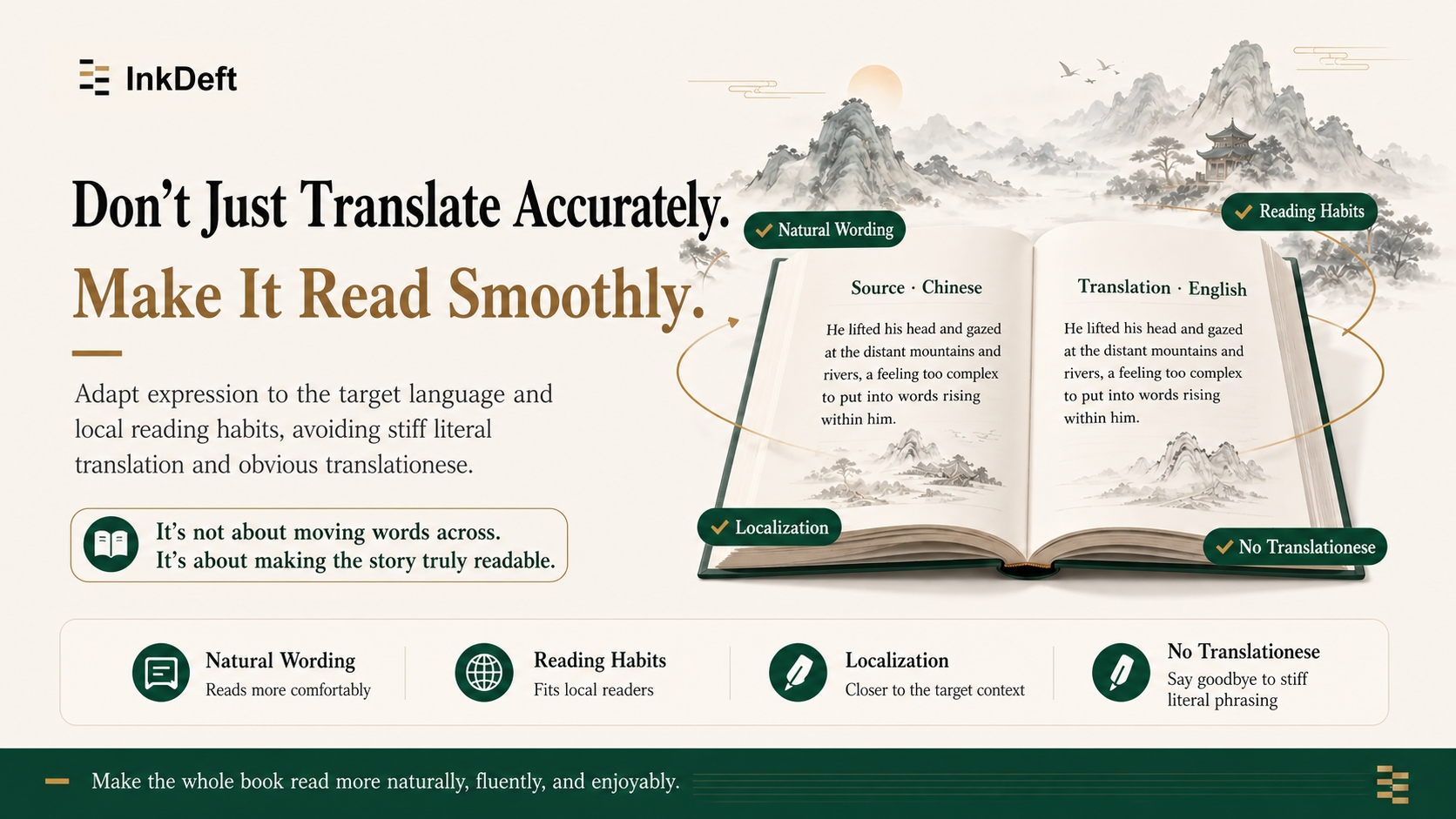
A novel can be translated correctly and still lose its voice, pace, and emotional pull in another language.
A manuscript passes its terminology check. Character names are correct. No major plot point has been mistranslated. On paper, the translation looks finished.
Then international readers open the book—and struggle to stay with it.
The dialogue feels formal when the scene should feel intimate. A tense confrontation moves like an explanation. A character who sounded restrained in the original suddenly sounds cheerful, blunt, or generic. Nothing is obviously wrong, yet the story no longer creates the same reading experience.
This is the gap between translating a novel accurately and making it work for readers in another language.
Accuracy is the starting point, not the reading experience
Accuracy protects the facts of a story. It keeps actions, relationships, settings, and plot developments intact. That is essential—but readers do not experience a novel as a list of facts.
They experience it through voice, rhythm, tension, and expectation.
A line can preserve every piece of information and still feel wrong because it is too long for the moment. A literal form of address may be technically defensible but confusing to a reader who does not share the same cultural context. A sentence may be grammatically polished while sounding unlike anything that character would naturally say.
For informational content, clarity may be enough. For fiction, the translation also has to answer a harder question:
Does this passage create the right response in the target reader?
That may require changing sentence length, reordering information, or choosing an expression that carries the function of the original rather than its exact surface form. The goal is not to rewrite the story. It is to preserve what the story is doing.
Character voice has to survive the language change
Readers learn who a character is through hundreds of small choices: what they call other people, how directly they speak, what they leave unsaid, and how their language changes under pressure.
Those choices are easy to flatten in translation.
A reserved protagonist should not become unusually expressive because the target language favors explicit wording. A teenager should not sound like a corporate memo. A powerful character may use very few words precisely because the scene already establishes their authority.
Forms of address are especially difficult. In some languages, a title or kinship term can communicate hierarchy, intimacy, irony, and emotional distance at the same time. A dictionary may offer several correct equivalents, but only the scene can tell the translator which relationship matters most.
Strong fiction translation therefore tracks more than names. It tracks the role each expression plays in the story:
• Who is speaking, and to whom?
• What is the relationship at this point in the plot?
• Is the line respectful, affectionate, hostile, evasive, or sarcastic?
• Has the character’s way of speaking changed for a story-driven reason?
The wording may vary from scene to scene. The character should not.
Genre expectations change what “natural” English sounds like
There is no single neutral style that works for every novel.
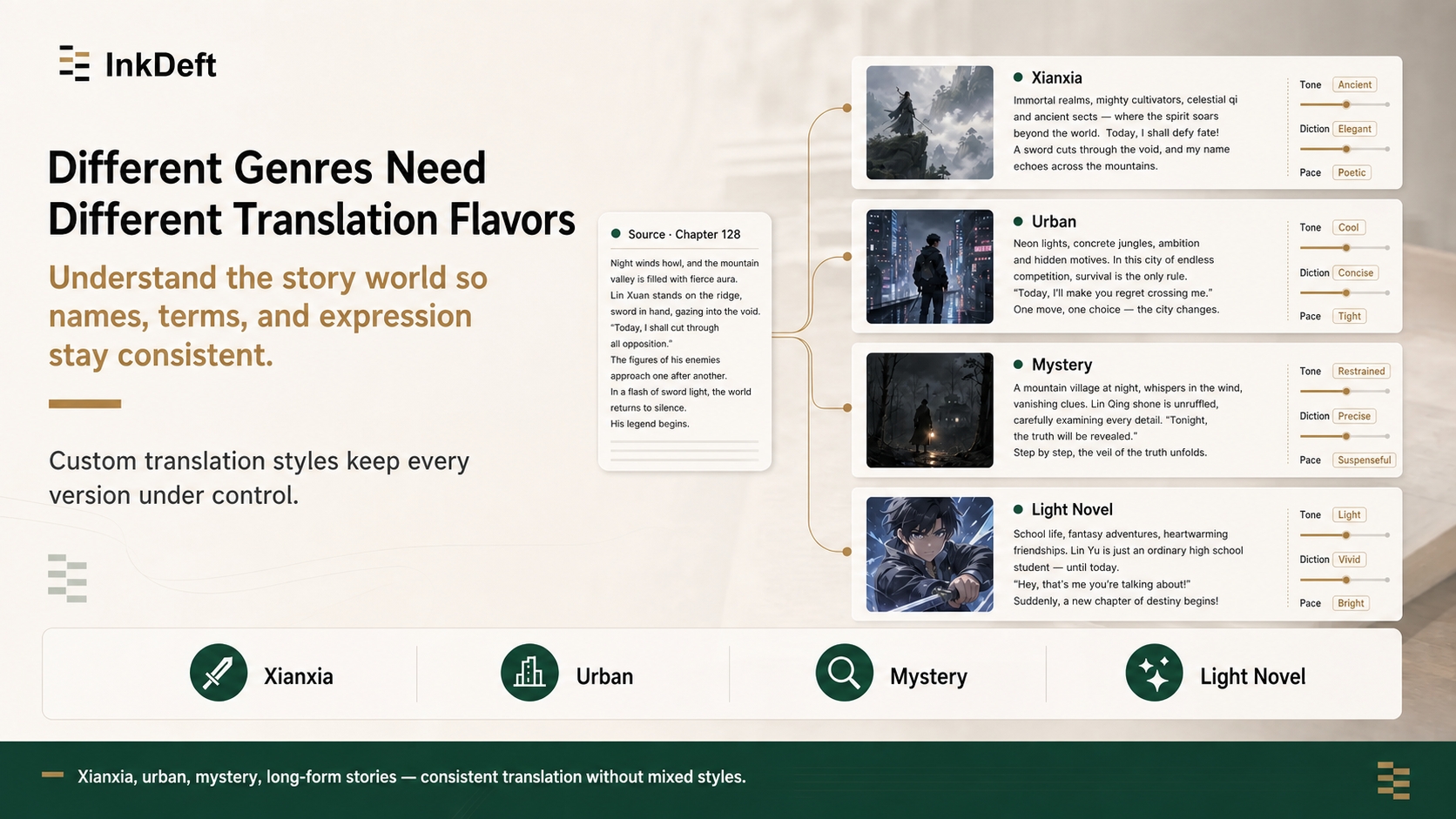
Fast-moving web fiction needs momentum. Romance depends on emotional distance and release. Mystery relies on controlled information. Fantasy must make an unfamiliar world understandable without turning every scene into an explanation.
A translation can become easier to understand and still weaken the genre if it removes too much tension, makes dialogue overly explicit, or explains cultural ideas at the exact moment the story should be moving.
The opposite approach is no better. Leaving every expression close to the source may preserve cultural markers, but it can force international readers to decode the language before they can follow the scene.
The practical goal is balance: retain the world and tone of the original while giving target-language readers enough context to stay inside the story.
That decision cannot be made once for the entire book. It has to remain consistent across dialogue, narration, action, description, and recurring cultural concepts.
A strong sample chapter does not guarantee a consistent full book
Short passages are forgiving. A translator can hold the relevant details in mind and polish each paragraph closely.

Long-form fiction creates a different problem. After dozens or hundreds of chapters, small variations begin to accumulate:
• Character address: a character is addressed differently without a plot reason
• Recurring terms: a location or technique receives a new name
• Relationship tone: a formal relationship gradually becomes casual by accident
• Long-range meaning: a key term is reinterpreted when it reappears much later
• Narrative voice: the style shifts as the project continues
Each instance may look minor. Together, they make the world harder to follow and the book feel less cohesive.
Long-form translation needs a working memory for the entire project: character relationships, terminology, titles, world-building, narrative tone, and decisions already confirmed in earlier chapters. It also needs review across chapters, because many consistency problems are invisible when each file is checked in isolation.
This is why a novel translation cannot be evaluated only sentence by sentence. The real unit of quality is the book.
InkDeft is built for book-length translation, not isolated passages
InkDeft treats a novel, web-fiction series, or other long-form manuscript as one continuing project.
The process begins by aligning on the writing style, character voices, and key translation choices through representative material. Translation then proceeds with the wider book context in view, while names, terminology, forms of address, relationships, and narrative style are checked across chapters.
Before delivery, the focus is not limited to whether individual sentences are correct. The translated manuscript is reviewed for the qualities readers actually experience:
• Natural expression: the prose reads naturally in the target language
• Character voice: each speaker remains recognizable and consistent
• World-building: terminology and story rules remain stable
• Genre fit: pacing and tone match the reading experience readers expect
• Continuity: the full text holds together across chapters
For publishers, web-fiction platforms, and content teams, that changes the deliverable. Instead of receiving disconnected translated chapters that still require a full consistency pass, the team receives a long-form translation prepared as a coherent work.
Learn more about InkDeft
Visit the website: https://inkdeft.com/
Submit your translation project: https://inkdeft.com/contact/