
Why Names, Worldbuilding, and Voice Drift Across a 300-Chapter Translation
Keep names, worldbuilding, and narrative voice consistent across long novels with context-aware translation and cross-chapter continuity.
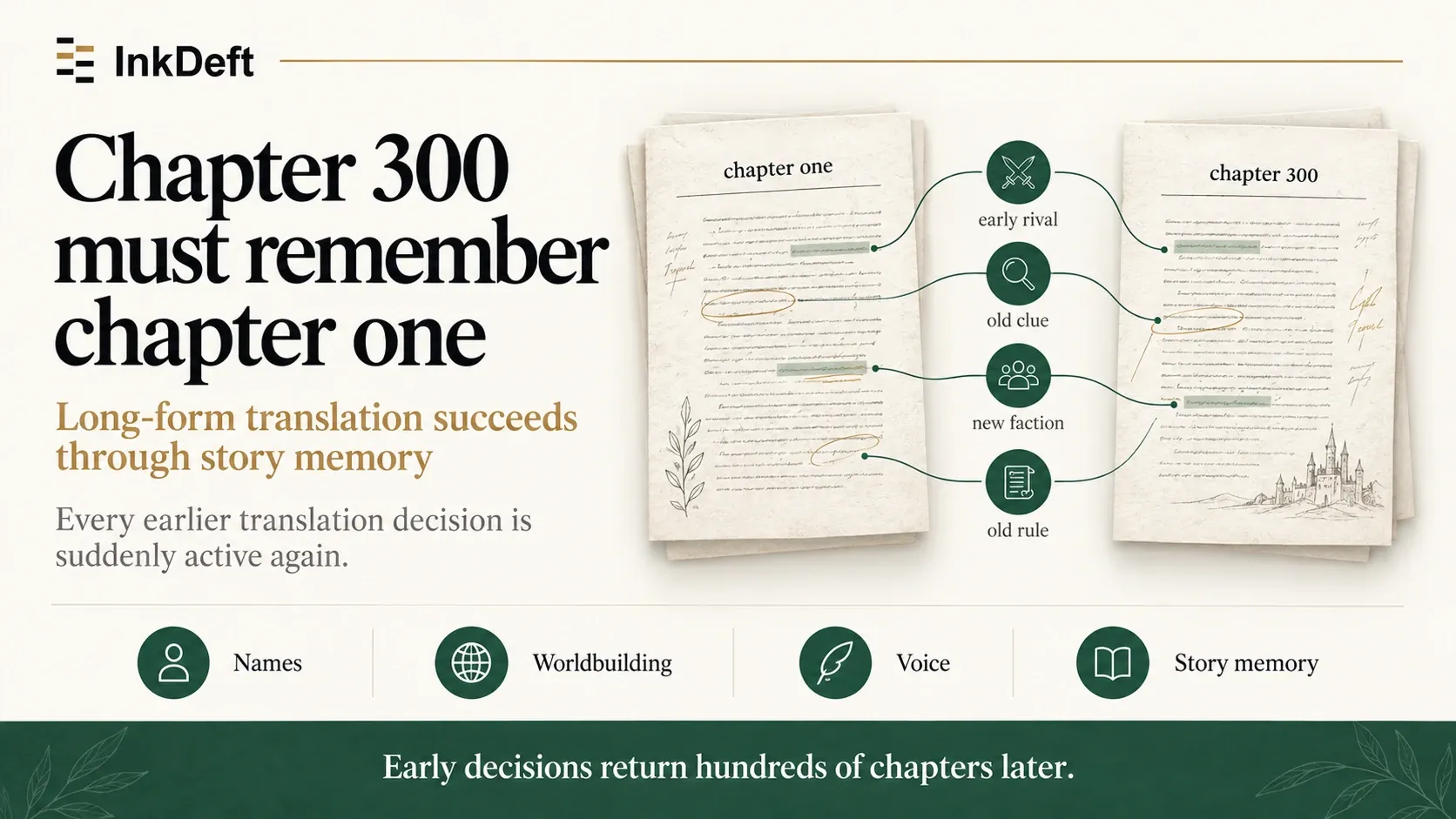
Early chapters rarely reveal the hardest problems in a web novel translation. The cast is still small, the world is only beginning to expand, and names and terms are easy to track.
Hundreds of chapters later, an early rival returns, an old clue becomes important, and a new faction connects to a rule introduced long ago. Every earlier translation decision is suddenly active again.
Later chapters inherit an entire story
The first appearance of a character establishes more than a name. It establishes rank, relationships, forms of address, and a recognizable way of speaking. A later chapter may refer only to an old nickname or past event because the source reader already understands the connection.

If the translator sees only the current chapter, the returning character can be mistaken for someone new. A restrained speaker may acquire an unexpectedly expressive voice. A meaningful change of address may disappear.
Chapter-level accuracy cannot replace book-level memory.
Forms of address are part of the plot
One character may have a personal name, title, family nickname, and hostile label. These are not interchangeable tags. They reveal who is speaking, the social setting, and how the relationship has changed.
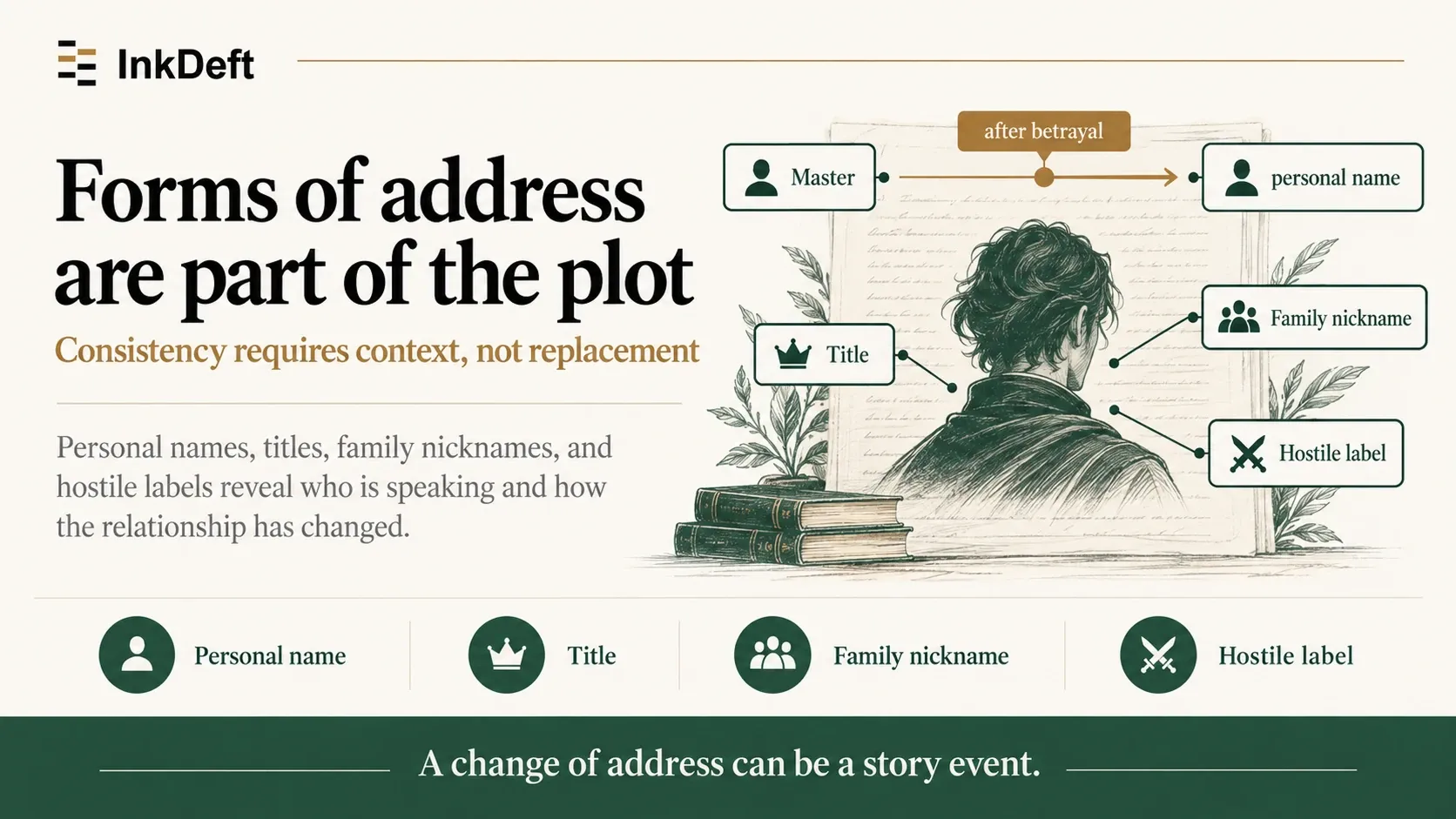
A disciple moving from “Master” to a personal name after a betrayal is a story event. The same change before that conflict would invent a relationship shift the author did not write.
Consistency therefore requires context, not a global search-and-replace.
Terminology protects the world’s logic
Cultivation levels, abilities, organizations, and artifacts often operate as connected systems. A term can remain linguistically plausible while quietly changing the rules.
If a defensive ability later sounds offensive, or one realm receives two unrelated names, readers can no longer judge the significance of a breakthrough. A terminology record must capture what an item is, where it sits in the system, and how it affects later events—not only how it is spelled.
Voice must remain continuous without becoming flat
Style consistency does not mean identical sentence length everywhere. It means that the genre, narrative rhythm, and character voices evolve for story reasons rather than production reasons.
InkDeft approaches novels and serialized fiction with the full work in view. Character identities, address patterns, terms, world rules, and voice decisions can be maintained and expanded as new chapters introduce new information.
The result should not feel like a stack of individually fluent chapters. It should feel like one story whose people and world remain recognizable across its full length.
Learn more about InkDeft
Visit the website: InkDeft official website
Submit your project: Contact us