
How to Localize Web Fiction for Multiple Markets Without Losing the Original Story
Each market needs its own reading rhythm and cultural choices, while characters, plot, terminology, and story rules must stay aligned across languages.
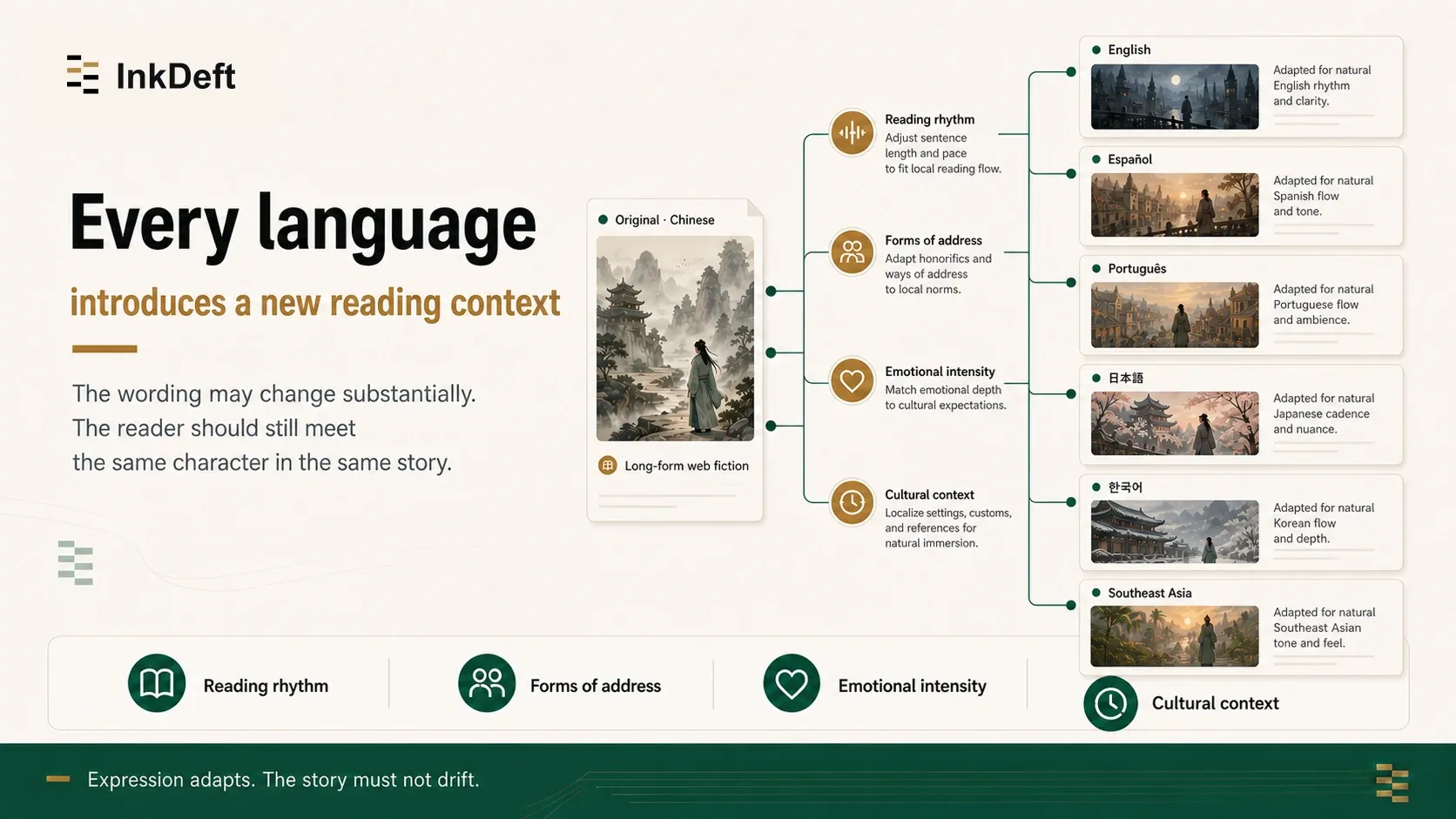
*Adding another language is not simply adding another translation file. Each market requires its own reading rhythm and cultural decisions, while the characters, plot, and story world must remain consistent across every version.*
Expanding a web novel into English, Spanish, Portuguese, Japanese, Korean, and Southeast Asian markets quickly becomes more than a translation-volume problem.
The same scene may need a more direct sentence structure in English, a different form of address in Japanese, or market-specific wording in Spanish. Dialogue intensity, sentence length, and cultural explanation may all change. The underlying character choice and plot logic cannot.
A successful multilingual release allows the expression to adapt without allowing the story itself to drift.
Every language introduces a new reading context
Chinese web fiction often carries relationship information through titles and forms of address. It may build emotion through layered description or rely on genre conventions that local readers recognize immediately.
Other markets process those signals differently. The localization team therefore needs to separate what must remain shared from what should be adapted.
Shared across all languages:
• character identities, relationships, and motivations
• plot facts, foreshadowing, and causal links
• worldbuilding rules and recurring terminology
• the core genre and personality of the work
Adapted for each market:
• sentence structure and natural phrasing
• forms of address, politeness, and emotional intensity
• explanations for culture-specific concepts
• pacing that fits local reading expectations
The wording may change substantially. The reader should still meet the same character in the same story.
English should not become the default source for every other language
An English edition has already made choices about Chinese titles, wordplay, cultural context, and sentence structure. Translating later editions from that English version means working from a text in which some original information has already been simplified or rearranged.
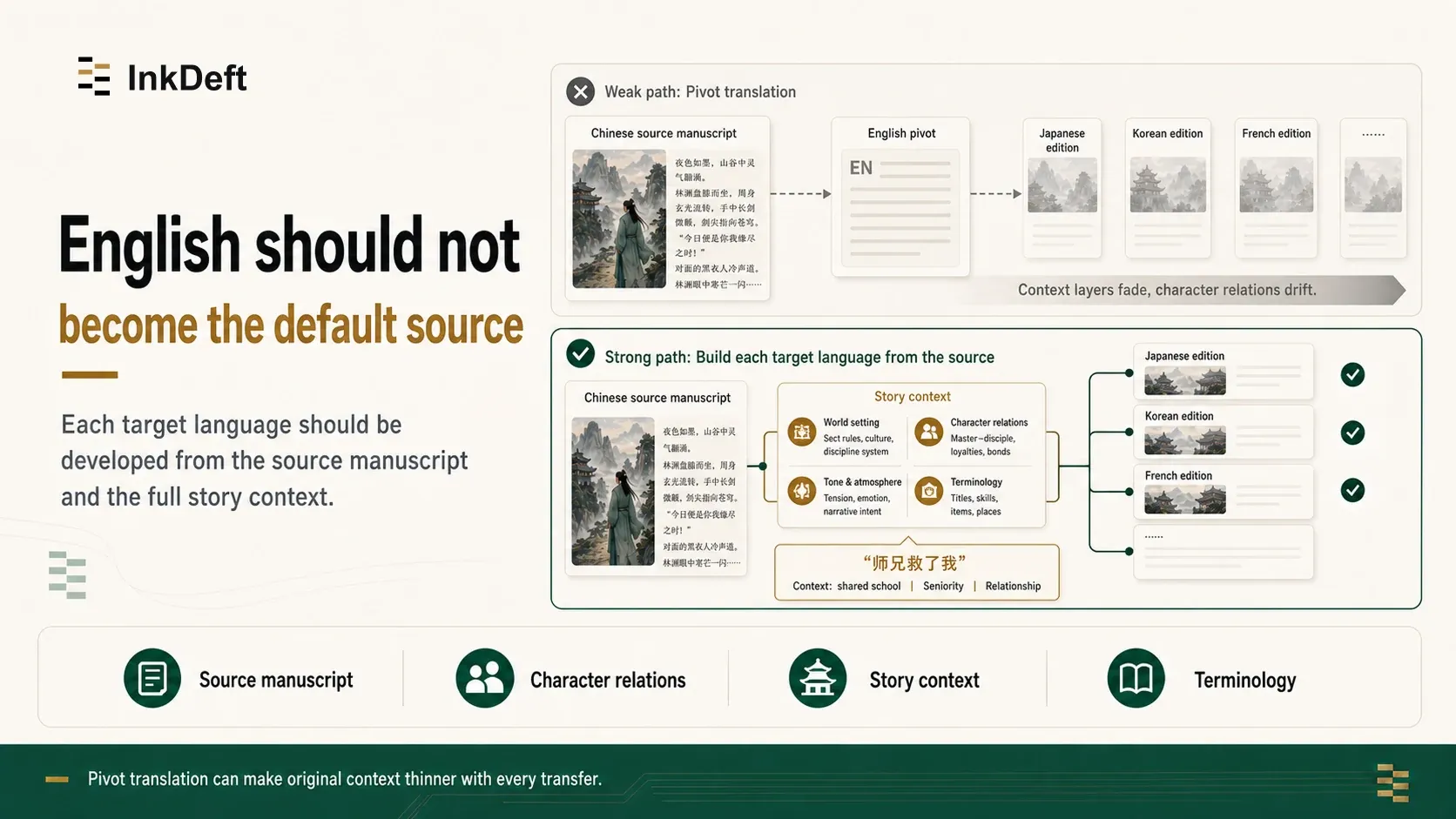
Take a line such as “师兄救了我.” Its function extends beyond “an older man saved me.” It signals a shared school or sect, seniority, and the speaker's relationship to that person. English may need context to make the relationship clear. Japanese may require a specific form of address. Spanish may need a more explicit phrase to preserve the same social information.
If later translators see only a simplified English line, those layers can become thinner with every transfer.
Each target language should therefore be developed from the source manuscript and the full story context—not from English as the only pivot language.
A shared story bible should guide market-specific decisions
Multilingual localization works best when the project maintains one shared source of truth for the story and separate decision records for each market.
The shared layer can include:
• character profiles and relationship changes
• names, locations, ranks, techniques, and recurring terms
• worldbuilding rules and timeline facts
• key tone and genre expectations
The market layer records how those elements are expressed naturally in each language. This makes it possible to keep the same canon while allowing different phrasing, honorifics, and cultural explanations.
It also gives editors a basis for review. They can see whether a difference is an intentional localization choice or an accidental change to the story.
Source updates can create different answers in every market
Web fiction rarely remains static. Authors add foreshadowing, revise a character identity, or change chapter order. Platforms may also request new packaging or release sequences.
For a multilingual project, every source update raises several questions:
• Which language versions were produced from the previous text?
• Which chapters and story references are affected?
• Which delivered files need to be replaced?
• How will the new version remain aligned across markets?
Without clear relationships between manuscript, chapter, language, and delivery version, one source edit can produce several inconsistent outcomes.
Efficiency therefore comes from traceable project structure, not simply from translating each sentence faster.
Localization can vary by market without rewriting the work
North American romance readers, Latin American serial-fiction readers, and Japanese or Korean genre audiences may respond to different levels of directness, emotional intensity, pacing, and explanation.
Those expectations can shape how information is ordered and expressed. They should not silently change a character's agency, the cause of a conflict, or the rules of the fictional world.
Good localization operates at the point where the reader receives the story. It preserves what happened and why while making the scene feel natural in the target language.
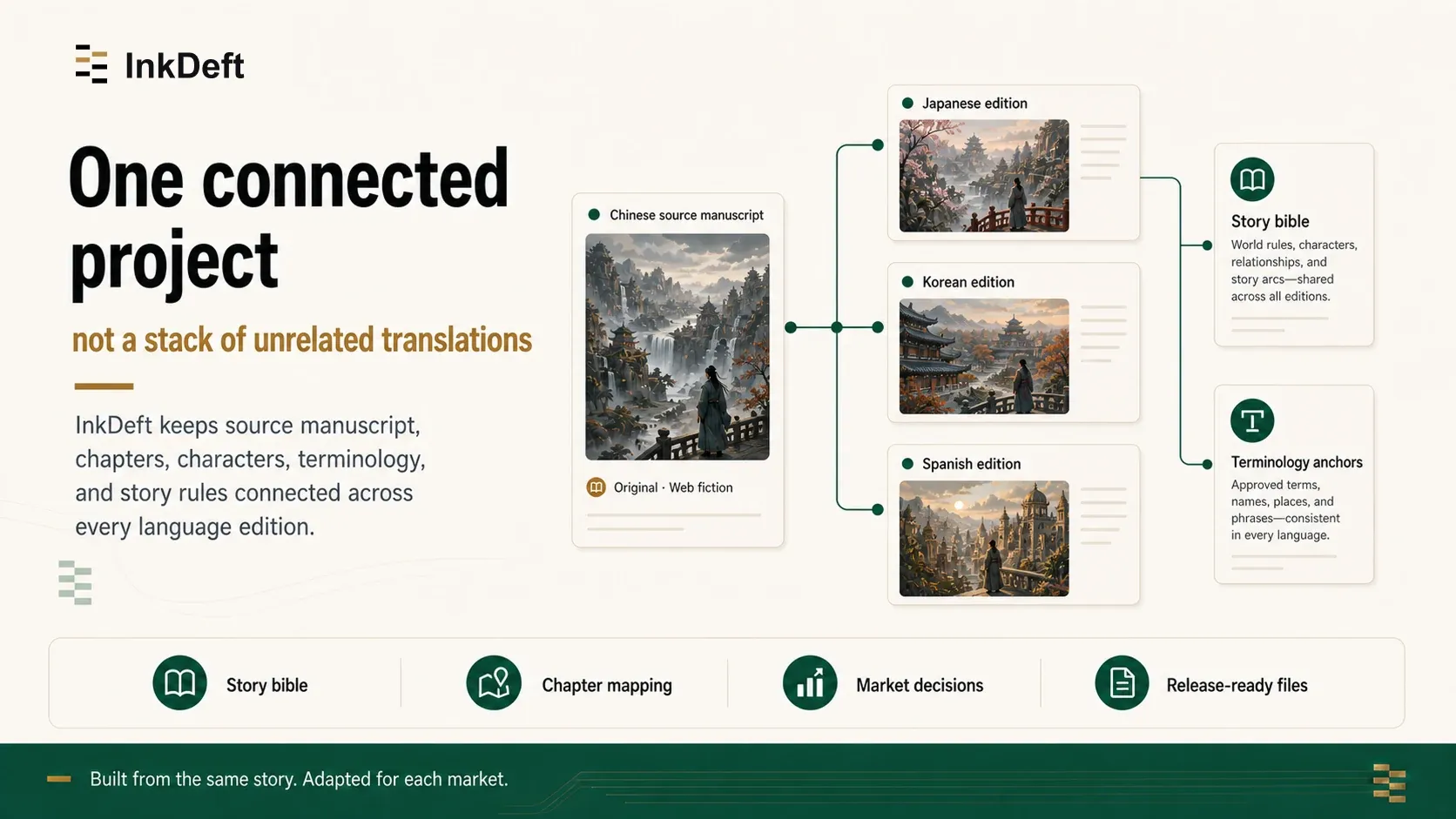
InkDeft organizes multilingual fiction as one connected project
InkDeft approaches novels and web fiction as long-form projects rather than collections of isolated passages. The source manuscript, chapter structure, characters, terminology, and story rules provide the shared foundation for each target language.
Each market can then receive language-specific localization decisions without losing alignment with the original work. When the source text changes, the affected chapters and language versions can be identified within the same project structure.
For content teams, this reduces the need to rebuild background materials and file-management processes for every language. Shared facts remain shared; market-specific expressions are handled separately; final files are organized for review, revision, and release.
The result is not a stack of unrelated translations, but a set of complete language editions built from the same story.
Learn more about InkDeft
Visit the website: Learn about InkDeft
Submit your translation project: Contact us